
Teenagers are not that interested in Facebook


Image result for teens and social media
Numerous social media companies fight for teens attention
Not long ago, a study was conducted detailing the social media usage of teenagers, and surprisingly (or not), Facebook did not come in at the top of the list. In fact, Facebook came in at the center of the pack with only 51% of teenagers using the platform. Compared to the 85% for YouTube and 72% for Instagram, Facebook is fading quickly from the forefront of social gathering.

(Note: Instagram is owned by Facebook)

The real question is, "why are teens abandoning the platform?" To me, it is not a simple as a single reason, but more a combination of factors. Firstly, the platform has quickly diluted and lost the "coolness" it once had. Now, not to insult anyone, but no teenager or tween wants to share their life and spend their time on a platform that their parents or grandparents are on. Once upon a time, Myspace was the overrun platform and Facebook was young and fresh; if you look today, I am sure most people will find that their parents/grandparents occupy more of their timeline than their friends do.
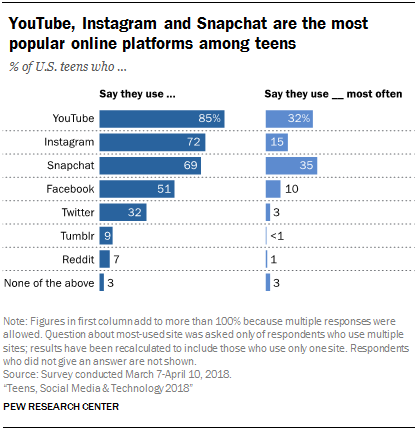
Studies show YouTube is the most popular platform for Teens
PEW RESEARCH CENTER
Another reason for the decline of Facebook is the competition in the sector. When Facebook ran over Myspace on its way to the top, it really only had AIM to partially compete against; it then enjoyed a nice, long run at the top. However, compare that time with the landscape today where most find their time split between Twitter, Instagram, YouTube, and Snapchat; hell, even Google+ managed to carve out a small niche of the market. The market for social media is a crowded one that gets inundated with new, hungry competitors on a daily basis.

The biggest concern with the amount of competition is the content and space they can offer. Most people, especially younger people, love visual media which Facebook is far from the best at. If you want to view and post pictures, you are heading to Instagram first; for videos, YouTube offers the best platform. For quick messages and pictures, Snapchat offers an excellent app, and Twitter is the king of quick updates. Facebook, while trying to be the king of everything, has allowed challengers to make a home in each section of its country. Rather than focus on what it was the best at, it tried to be a jack-of-all-trades much like Apple before the return of Steve.

Does Facebook still have a product to offer in today's world? Of course. Marketplace, in my opinion, was one of the best additions to the platform since its creation, and event invites are still a prime way to organize events. However, if they continue trying to do too much (like with Messenger), they may find an aging clientele with no new prospects; scandals such as Cambridge Analytica are certainly not helping their cause either.

Comments

Popular posts from this blog

Where do tablets belong?

Last night, I had a sudden thought: where does my tablet belong in my tech life? I have always loved the thought of having a need and purpose for every piece of technology I own. For instance, my computer does all of my heavy lifting (photo and video editing) while my phone does all of communicating and daily living tasks. My Chromecast ? That is for tossing music and videos to my TV. Google Home Mini ? What a great little assistant for quick information and getting my day started. I use my Xbox for gaming while my Huawei Watch gives me quick updates and almost-hands-free communication. So, where does my Kindle come in? I originally bought my Kindle Fire to be a consumption device and makeshift pseudo-laptop as mine is not very portable. I thought I would use it for all of Netflix watching as I moved about the house as well as for reading plenty of books; I even intended it to be useful to bang out a quick blog post or article. We probably had a great relationship at first...and ...

Digital well-being is the trend of the year

Digital well-being is this year's buzzword With the keynote of WWDC officially over, it is safe to say one thing: digital well-being is the trendy topic of the year. I/O last month and WWDC have demonstrated that the key players in mobile devices (seemingly) want you to put your phone down. However, which company has the right idea in how to do it? Both iOS 12 and Android P have showcased coming features to address "digital well-being". For all intents and purposes, these words just mean that Apple and Google "want" you to spend less time on your phone; at least, that is the image they are portraying. Both iOS and Android offer new dashboards Now, how are they both doing it? While they differ in the approach, they have very similar tools. For instance, both operating systems will allow you to set timers on apps so that you can spend as much or as little times in those apps as you choose. If you go over, you get shut out of the app. In additio...

In-display sensors or facial scanners: which will take off?

The fingerprint sensor may be moving back to the front...under the screen. Could this be the next big trend in mobile technology (see previous entry about current trend)? Or, will companies move the Apple way and opt for facial recognition for security? With the debut of the iPhone X, Apple shifted away from the fingerprint sensor and debuted FaceID. Utilizing (arguably) some of the most advanced cameras and sensors, the iPhone X negated the need for fingerprint, bio-metric security by using 3D facial recognition to verify identity. In doing so, the home button vanished from the iPhone along with the ability to scan fingerprints. Several months later, at CES, Vivo demoed the first phone using in-display fingerprint scanner technology ; the idea being to remove bezels on the front as well remove the sensor from the back of the body. Prior to CES, many believed that Samsung would be the first to debut the technology, but they were held back by mass-producing and technological restra...